Predictive Machine Learning models to estimate the price of gold [Modelos predictivos de Machine Learning para estimar el precio del oro]
DOI:
https://doi.org/10.32829/sej.v8i1.204Palabras clave:
Modelos de regresión; Precio del oro; Gradient boosting; Random Forest.Resumen
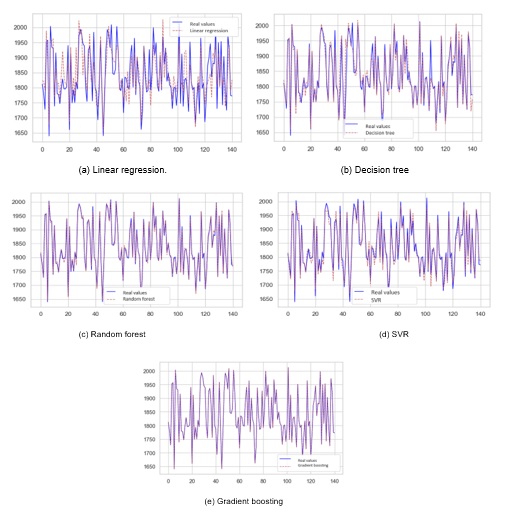
El propósito de este estudio fue determinar el algoritmo óptimo para estimar el precio del oro e identificar las variables más incidentes en su variación. Se usó una metodología de nivel exploratorio, enfoque cuantitativo y de diseño no experimental. Los resultados que se obtuvieron al realizar EDA muestran que las variables de mayor correlación con respecto al precio del oro son el costo de producción con 44 % y el S&P_500 con 30 %. Al validar los modelos dieron como resultado que el algoritmo de Gradient boosting tiene un R2 óptimo con 99.4 %, dicho valor justifica la importancia del modelo para poder estimar el precio del oro. Así mismo sin dejar de lado el algoritmo de Random Forest también muestra un R2 de 99.3 %. Así mismo se identificó que las variables de mayor incidencia son el Cost_prod con un 51.5 % y el USD_X con un 30.4 %. Finalmente se concluye que el uso de estos algoritmos como el Gradient boosting y el Random Forest pueden estimar el precio del oro tomando en cuenta las variables que inci-den en su variación.
Descargas
Citas
Bakker A., Boels, L., Dooren W., Drijvers P. (2019). Conceptual difficulties when interpreting histograms: A review. Educational Research Review, 28. https://doi.org/10.1016/j.edurev.2019.100291 DOI: https://doi.org/10.1016/j.edurev.2019.100291
Cánovas F., Alonso F., Gomariz F., & Oñate F. (2018). Modification of the random forest algorithm to avoid statistical dependence problems when classifying remote sensing imagery. Computers & Geosciences, 103, 1-11. https://doi.org/10.1016/j.cageo.2017.02.012 DOI: https://doi.org/10.1016/j.cageo.2017.02.012
Campillo J. Martínez Julián & Carmona Pedro. (2018). Análisis de la utilidad del algoritmo Gradient Boosting Machine (GBM) en la predicción del fracaso empresarial. Spanish Journal of Finance and Accounting / Revista Española de Financiación y Contabilidad, 47, 1-26. doi.org/10.1080/02102412.2018.1442039 DOI: https://doi.org/10.1080/02102412.2018.1442039
Castillo O. (2022). Desarrollo de modelos predictivos de regresión en la industria minera mediante el uso de algoritmo de machine Learning. https://orcid.org/0000-0001-6996-923x.
Cohen G., & Aiche A. (2023). Forecasting gold price using machine learning methodologies. Chaos, Solitons & Fractals, 175. https://doi.org/10.1016/j.chaos.2023.114079 DOI: https://doi.org/10.1016/j.chaos.2023.114079
Courtney M. (2021). Exploratory Data Analysis in Schools: A Logic Model to Guide Implementation. Internatioal Journal of Education Policy & Leadership, 17(4). https://doi.org/10.22230/ijepl.2021v17n4a1041 DOI: https://doi.org/10.22230/ijepl.2021v17n4a1041
Diaz H., Ramírez S., & Salazar F. (2020). Los determinantes de las variaciones en el rendimiento del oro. La revisión por pares es responsabilidad. 65(2), 1-28. http://dx.doi.org/10.22201/fca.24488410e.2018.1973 DOI: https://doi.org/10.22201/fca.24488410e.2018.1973
Espinosa Z & Javier J. (2020). Aplicación de algoritmos Random Forest y XGBoost en una base de solicitudes de tarjetas de crédito. Ingeniería, investigación y tecnología, 21(3), 00002. https://doi.org/10.22201/fi.25940732e.2020.21.3.022 DOI: https://doi.org/10.22201/fi.25940732e.2020.21.3.022
Espinoza S. (2020). Predicción de postulantes que cometerán fraude interno con Algoritmo de aprendizaje supervisado.
Ghule & Gadhave (2022). Gold Price Prediction using Machine Learning. International Journal of Scientific Research in Engineering and Management (IJSREM), 06. DOI: 10.55041/IJSREM15027. DOI: https://doi.org/10.55041/IJSREM15027
González R. S. L., Gómez I., Pastrana J. L., & Hernández A. (2018). Algoritmos de clasificación y redes neuronales en la observación automática de registros. Cuadernos de Psicología del Deporte, 15(1), 31-40. https://dx.doi.org/10.4321/S1578-84232015000100003 DOI: https://doi.org/10.4321/S1578-84232015000100003
Gulandi S., & Toscani G. (2018). Human behavior and lognormal distribution. A kinetic description. Department of Mathematics of the University of Pavia and IMATI CNR, Italy. Vol. 1.
Khani M., Vahidnia S., Abbasi A. (2021). A Deep Learning-Based Method for Forecasting Gold Price with Respect to Pandemics. SN Computer Science. https://doi.org/10.1007/s42979-021-00724-3. DOI: https://doi.org/10.21203/rs.3.rs-111705/v3
Liang Y., Lin Y., & Lu Q. (2022). Forecasting gold price using a novel hybrid model with ICEEMDAN and LSTM-CNN-CBAM. Expert Systems with Applications, 15. https://doi.org/10.1016/j.eswa.2022.117847. DOI: https://doi.org/10.1016/j.eswa.2022.117847
Makala D., & Li Z. (2021). Prediction of gold price with ARIMA and SVM. Journal of Physics: Conference Series. doi:10.1088/1742-6596/1767/1/012022. DOI: https://doi.org/10.1088/1742-6596/1767/1/012022
Nicodemo C., & Satorra A. (2022). Exploratory data analysis on large data sets: The example of salary variation in Spanish Social Security Data. Article Reuse Guidelines, 25. https://doi.org/10.1177/2340944420957335. DOI: https://doi.org/10.1177/2340944420957335
Ochoa L. (2020). Evaluation of Classification Algorithms using Cross Validation. LACCEI International Multi-Conference for Engineering, Education, and Technology. http://dx.doi.org/10.18687/LACCEI2019.1.1.471. DOI: https://doi.org/10.18687/LACCEI2019.1.1.471
Reales Chacón L., Robalino Morales G. E., Peñafiel Luna A. C., Cárdenas Medina J. H., Cantuña-Vallejo P. F. (2022). El Muestreo Intencional No Probabilístico como herramienta de la investigación científica en carreras de Ciencias de la Salud. Revista Universidad y Sociedad, 14(S5), 681-691. https://orcid.org/0000-0002-4242-3429.
Rodríguez A. (2021). Implementation of Artificial Intelligence algorithms in the prediction of new knowledge through constructivist teaching. Vol. 14(No. 3). doi: https://orcid.org/0000-0002-1238-0106.
Sadorsky P. (2021). Predicting Gold and Silver Price Direction Using Tree-Based Classifiers. Journal of risk and financial management, 14(5). https://doi.org/10.3390/jrfm14050198. DOI: https://doi.org/10.3390/jrfm14050198
Sandoval L. (2019). Machine Learning algorithms for analysis and data prediction. 2017 IEEE 37th Central America and Panama Convention (Concapan xxxvii), 1-5. Managua, Nicaragua. IEEE. http://doi.org/10.1109/Concapan.2017.8278511. DOI: https://doi.org/10.1109/CONCAPAN.2017.8278511
Sević J., & Stakić A. (2022). Prediction of gold price movement considering the number of infected with the covid 19. The European journal of applied economics, 19(2). DOI: DOI 10.5937/EJAE19-39258. DOI: https://doi.org/10.5937/EJAE19-39258
Talavera F. J. (2020). Fundamentos Metodológicos de la Investigación: El Génesis del Nuevo Conocimiento. vol. 5(núm. 16). doi: https://doi.org/10.29394/Scientific.issn.2542-2987.2020.5.16.5.99-119 DOI: https://doi.org/10.29394/Scientific.issn.2542-2987.2020.5.16.5.99-119
Tebin J. y James A. (2022). Gold Price Prediction using Machine Learning. Proceedings of the National Conference on Emerging Computer Applications (NCECA), 4. DOI: 10.5281/zenodo.6874188.
Villada F. (2018). Artificial Neural Networks applied to the Prediction of the Gold Price. vol.27(no.5). doi: http://dx.doi.org/10.4067/S0718-07642016000500016 DOI: https://doi.org/10.4067/S0718-07642016000500016
Wagh A., Shetty S., Soman A., Maste D. (2022). Gold Price Prediction System. International Journal for Research in Applied Science & Engineering Technology (IJRASET), 45(98). https://doi.org/10.22214/ijraset.2022.41623. DOI: https://doi.org/10.22214/ijraset.2022.41623
Zúñiga P. I. (2019). Metodología de la investigación científica: guía práctica. Vol. 7 Núm. 4(Núm. 4). doi: https://orcid.org/0009-0001-9418-8707
Descargas
Publicado
Cómo citar
Número
Sección
Licencia
Derechos de autor 2024 Journal of Sciences and Engineering

Esta obra está bajo una licencia internacional Creative Commons Atribución 4.0.